A common misconception: a capsule wardrobe means owning fewer clothes. That’s not quite right. A capsule wardrobe means owning clothes that actually work together. Most men own 40+ items but can only make 3 outfits. That’s not a wardrobe. That’s a collection of mistakes.
This article walks through a specific 12-piece system for business casual. No guesswork. No “buy what feels right.” Just a framework that courts have generally found to produce reliable results — if you follow the rules.
This is not legal advice — consult a licensed attorney for employment contract questions about dress codes. This is wardrobe advice.
The Suit Jacket Problem: Why Most Men Buy Wrong First
The single biggest failure mode in business casual: buying a suit jacket that can’t stand alone. Men walk into a store, buy a full suit, then wear the jacket with chinos. The jacket looks too structured. The trousers sit in the closet unworn. This is a $600 mistake.
The solution is a sport coat — not a suit jacket. A sport coat has softer construction, often with patch pockets and a more textured fabric. It’s designed to pair with non-matching trousers. A suit jacket is designed to pair with its matching trousers only.
Fabric and color rules
Navy blue in a wool or wool-blend fabric. Not black. Not charcoal. Navy works with gray trousers, khaki chinos, and dark denim. The texture should be visible — hopsack, birdseye, or a subtle herringbone. Solid navy reads as “I tried too hard.” Textured navy reads as “I know what I’m doing.”
Price point: $400-$800 for a quality sport coat that will last 5-7 years. Brands like Suitsupply, Spier & Mackay, and Brooks Brothers offer reliable options at this range. Avoid anything under $200 unless you find a deep sale on a known brand.
The one-jacket rule
For a 12-piece capsule, you get one jacket. One. That’s it. If you need more variety, swap the sport coat for a blazer in a solid navy. But a textured sport coat gives you more outfit combinations. A blazer works best if your workplace leans formal. A sport coat works best if you need to dress down on Fridays.
Three Trousers That Cover Every Situation
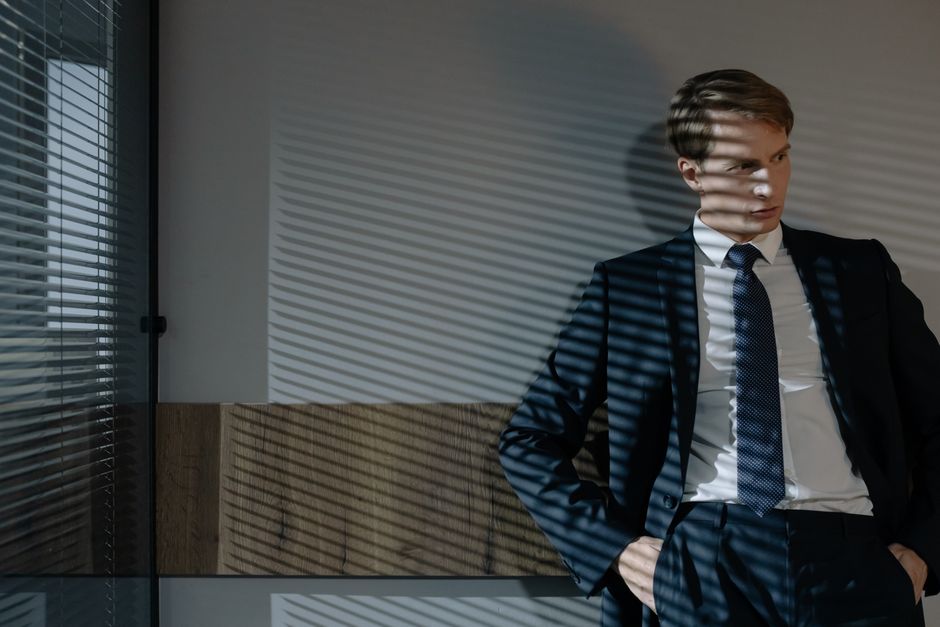
Here is where most men overbuy. They own 8 pairs of pants but none that work for a client meeting AND a casual Friday. The fix is three specific trousers, each serving a distinct role.
| Trouser Type | Color | Fabric | Best Paired With | Price Range |
|---|---|---|---|---|
| Wool dress trousers | Charcoal gray | Worsted wool, 280-320g | Sport coat, oxford cloth button-down | $150-$250 |
| Cotton chinos | Khaki / beige | 100% cotton twill, 8-10oz | Sport coat, polo shirt, sweater | $70-$120 |
| Dark denim | Raw or dark rinse indigo | 100% cotton, 12-14oz | Sport coat, sweater, polo | $80-$150 |
Key rule: the denim must be free of rips, fading, or whiskering. Dark, clean, and pressed. Levi’s 511 or 513 in “rigid” or “dark wash” works. Uniqlo’s selvedge denim at $50 is a strong budget option.
The chinos should have a flat front, not pleats. Pleats add visual bulk and date the look. J.Crew’s 770 chinos or Bonobos weekday warriors are reliable. The wool trousers should have a medium rise — not low (shirt untucks easily) and not high (looks dated).
Failure mode: buying all three in the same fit. The wool trousers should be slightly slimmer than the chinos. The denim should be the slimmest. Different fits for different fabrics avoid the “uniform” look.
Four Shirts That Do the Heavy Lifting
Four shirts. Not ten. Four. Each must work with all three trousers and the sport coat. That’s 12 outfit combinations minimum from shirts alone.
Shirt 1: White oxford cloth button-down (OCBD)
This is the anchor. A white OCBD with a button-down collar from Charles Tyrwhitt or Brooks Brothers. The button-down collar is critical — it’s less formal than a spread collar and works without a tie. The oxford cloth is casual enough for chinos but structured enough under a sport coat. Price: $40-$90 on sale.
Shirt 2: Light blue pinpoint oxford
Same collar style, same fabric weight, different color. Light blue is the second-most-versatile shirt color after white. It pairs with charcoal trousers for a classic lawyer look, or with dark denim for a modern casual vibe. Mizzen+Main makes a wrinkle-resistant version that works for travel-heavy professionals.
Shirt 3: White or light gray polo
This is your casual Friday shirt. A polo with a knit collar, not a pique cotton collar that curls up. Sunspel makes the gold standard at $135. Uniqlo makes a decent version at $30. The key is fit — sleeves should hit mid-bicep, hem should hit mid-zipper. No logos larger than a dime.
Shirt 4: Navy merino wool crewneck sweater
Technically not a shirt, but it fills the same role. A lightweight merino crewneck (200-225g/m²) in navy. Wear it over the white OCBD with chinos or denim. Wear it alone with wool trousers. Uniqlo ($50) and Everlane ($80) offer solid options. Avoid cashmere for daily wear — it pills and requires dry cleaning. Merino can be machine washed on gentle.
Failure mode: buying all four in the same shade of blue. The navy sweater + light blue shirt + khaki chinos is a solid outfit. Navy sweater + navy trousers + navy shirt is a uniform. You need contrast.
Two Pairs of Shoes — Not Three, Not Five
Two pairs of shoes. One for formal business casual, one for relaxed business casual. That’s all you need. Men who own 10 pairs of shoes still wear the same two 80% of the time. Admit it and simplify.
Pair 1: Dark brown oxfords or derbies
Oxfords are more formal. Derbies are slightly more casual. Either works. The color must be dark brown — not black, not light brown, not burgundy. Dark brown pairs with charcoal, khaki, and navy equally well. Allen Edmonds Park Avenue in dark brown ($395) is the benchmark. Cole Haan Zerogrand in dark brown ($150) is a solid budget option with more cushioning.
Pair 2: Brown suede chukka boots or loafers
Suede chukka boots in medium brown. Clarks Desert Boots ($120) are the classic. Loafers in suede also work — G.H. Bass Weejuns ($100) or Rancourt ($350) for a higher-end option. The key is suede — it’s casual enough for denim and chinos but polished enough for the sport coat. Avoid leather loafers with business casual — they read as “I’m going to the country club” not “I’m going to the office.”
Failure mode: buying black shoes. Black shoes with khaki chinos looks like a rental tuxedo with sneakers. Black shoes with navy trousers looks like a mistake. Dark brown works with everything in this capsule. Trust the system.
The Accessories That Make or Break the System
This section is short on purpose. Accessories are not where you need variety. You need three items, and they must be right.
One belt: dark brown leather, 1.25 to 1.5 inches wide. Match the leather finish to your shoes. If your shoes are polished calfskin, get a polished calfskin belt. If your shoes are matte suede, get a matte leather belt. Anson Belt makes a no-hole system ($35) that adjusts in 1/4-inch increments — useful if your weight fluctuates.
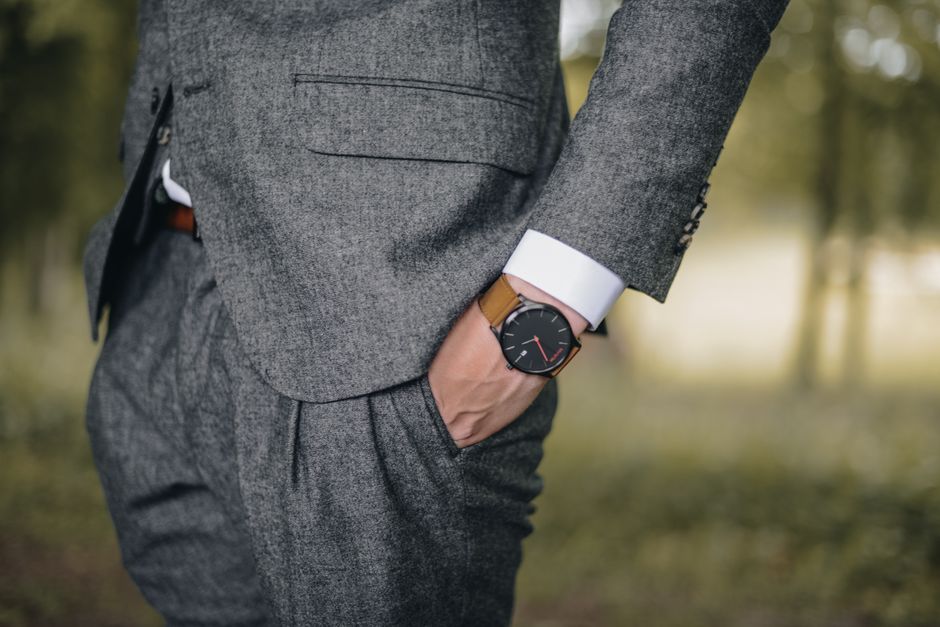
One watch: a simple stainless steel or brown leather strap watch with a white or cream dial. No chronographs, no dive bezels, no smartwatches. A Seiko 5 ($150) or Timex Marlin ($200) works. The watch should be seen as an afterthought, not a statement.
One bag: a brown leather briefcase or a canvas backpack in navy or olive. Leather is more formal. Canvas is more casual. Choose based on your office culture. Filson makes a canvas briefcase ($300) that lasts 20 years. Carl Friedrik makes a leather backpack ($450) that looks professional without screaming “I’m a consultant.”
Failure mode: wearing a black belt with brown shoes. Or a brown belt with black shoes. This is the single most common mistake in business casual. Courts have generally found that mismatched leather is grounds for dismissal from style consideration.
When the Capsule Fails — And What to Do About It

No capsule wardrobe is perfect for every situation. Here are three scenarios where this system breaks down and how to patch it without buying 10 more items.
Scenario 1: Your office requires a tie
If your dress code says “tie required,” this capsule needs one addition: a navy knit tie. Knit ties are less formal than silk and work with the sport coat and OCBD. The Tie Bar sells them for $25. One tie, one pocket square (white linen, simple fold), and you’re covered for client meetings. The rest of the capsule stays the same.
Scenario 2: You travel frequently
Add one more polo shirt (heather gray) and one more pair of chinos (navy). That’s two items. Now you have 14 pieces that create 30+ outfits, all packable in a carry-on. The merino sweater and wool trousers can be worn 3-4 times between washes. The sport coat goes in a garment bag. This is a tested system for consultants who live on planes.
Scenario 3: Your climate is extreme
Hot climate: replace the merino sweater with a linen-cotton blend button-down in white. Replace the wool trousers with lightweight cotton trousers (tropical weight, 220g or less). Suitsupply makes a linen-cotton sport coat that works for summer. Cold climate: add a wool overcoat in charcoal or camel. J.Crew makes a reliable wool topcoat at $250-$400. The overcoat is the only outerwear you need — it covers the sport coat, sweaters, and dress shirts.
Failure mode: adding items without removing others. The capsule stays at 12-14 pieces total. If you add a tie, remove something you never wear. If you add a topcoat, remove a jacket you don’t use. The system only works if you enforce the limit.
Final recommendation: start with the 12 pieces listed . Wear them for 30 days. After 30 days, identify which piece you reach for least often. Replace it with something that fills a gap. Do not buy anything else until you’ve worn every piece at least 5 times. This is not a shopping list. This is a system. Follow the system, and you will never stand in front of your closet wondering what to wear again.