Research in visual perception shows the human eye detects luminance contrast before it processes hue. We read light-versus-dark before we register colour. That single fact reshapes how you should think about getting dressed — and it explains why two people can wear the same colours and get completely different results.
My eye has shifted considerably over the past two years. Less chasing of trending shades, more obsessing over how tones sit next to each other. Here is what I have settled on — and what I have stopped doing.
Why Most People Misread Colour Contrast
The most common mistake is not wearing the wrong colours. It is confusing colour contrast with colour clash. They look similar at a glance. They feel completely different in practice. And the gap between them is almost always saturation, not hue.
Clash vs. Contrast: The Saturation Problem
Take a bright cobalt blue worn with a vivid tomato red. Both colours are fully saturated. Neither tone is dominant. The eye has nowhere to rest, and the result reads as noise rather than intention. Now take the same cobalt blue with a dusty terracotta — a muted, lower-saturation version of red-orange. Suddenly there is visual hierarchy. One tone advances, one recedes. That is contrast working properly.
The rule that has stuck: match saturation levels, not colour families. A muted olive pairs with a muted burgundy. A vivid yellow pairs with a vivid navy. Mix saturation levels — one punchy, one washed-out — and you get visual static regardless of how theoretically compatible the hues are.
This is the mistake that makes people declare they “cannot wear colour.” They can. They just tried to combine colours at different energy levels and it looked wrong, so they retreated to black.
The Skin Tone Variable Nobody Talks About Honestly
Every colour-in-fashion guide eventually mentions warm versus cool tones, tells you to hold fabric swatches near your face, and moves on. That advice is not wrong — it is just incomplete.
What actually matters more is the value contrast between your skin tone and the garment. Someone with very fair skin wearing pale blush creates almost no contrast. The outfit dissolves. The same person in deep navy creates high contrast — the face and the clothing snap into separate planes, and everything reads as deliberate. Neither is better. They produce categorically different effects, and you should choose based on what you want the eye to do.
Medium skin tones have more flexibility here, which is why most universal colour advice is quietly calibrated for medium skin. If you are working from either extreme, you will need to adjust accordingly. High contrast outfits hit harder on fair and deep skin tones — that can be a strength or an issue depending on the context.
The Proportion Problem Nobody Names
Even a well-matched colour pairing falls apart at the wrong ratio. A 50/50 split between two strong colours creates a fight for visual dominance. An 80/20 split gives you a primary tone with an accent — much easier to wear, and much more legible as a choice rather than an accident.
This is why a dark navy trouser with a terracotta knitwear piece works, but an equally divided navy-and-terracotta colour-block coat often does not. Same colours. Completely different outcome. Aim for 70/30 or 80/20 as a default. Reserve 50/50 splits for deliberately bold statements, and only when both tones are at the same saturation level so the tension reads as controlled rather than chaotic.
Contrast Pairings That Hold Up: A Practical Reference
Here is what consistently works across seasons and formality levels, rated honestly on execution difficulty:
| Pairing Type | Example | Difficulty | Why It Works | Where It Fails |
|---|---|---|---|---|
| Light / Dark (same hue family) | Pale grey + charcoal | Easy | Luminance contrast without colour risk | Reads as unfinished if tones are too close in value |
| Warm / Cool (muted versions) | Dusty rose + slate blue | Medium | Temperature contrast is inherently interesting | Fails when one tone is muted and the other is vivid |
| Neutral + one saturated accent | Camel + cobalt blue | Easy | Neutral grounds the saturated piece | Accent needs to be genuinely saturated, not mid-range |
| Complementary (muted versions) | Olive + rust | Medium | Opposite hues create tension; muting makes it wearable | Becomes drab if both tones skew too dark |
| Tonal (same family, different value) | Ivory + ecru + sand | Hard | Sophisticated layered depth when executed well | Reads as accident if tones are too similar |
| Bold complementary (vivid) | Electric blue + burnt orange | Hard | High visual impact, unmistakably intentional | Requires precise proportion and a clean silhouette |
The easy pairings are easy because luminance contrast — light versus dark — is doing most of the structural work. When value difference is high, the specific hues almost do not matter. The hard pairings require you to manage proportion, saturation, and silhouette simultaneously. They are worth learning, but they are not the starting point.
Worth noting: the “tonal” category at the bottom is harder than it looks because the margin for error is small. Too close in value and it looks like you grabbed whatever was clean. Exactly right and it is the most considered-looking thing in the room.
Brands That Execute Colour Contrast Consistently Well
Principles only get you so far. These are specific brands where the colour logic is already built into the product — and where the investment is justified for what you learn from wearing them.
- Cos — Their seasonal knitwear is arguably the best on the high street for studying tonal contrast in practice. The Relaxed Wool-Blend Jumper in deep burgundy (around £95) worn against their slim-cut ecru trousers (£69) is the formula they return to each autumn. The proportion and saturation are calibrated. This is not accidental.
- Arket — The Scandinavian approach here is warm-neutral dominance with one cool accent. Their cotton Oxford shirts in warm off-white (around £55) under a dusty steel-blue overshirt (£145) appears in their lookbooks almost every season because it works. The value contrast is medium throughout — nothing shocks, everything reads as considered.
- Uniqlo U — Christophe Lemaire’s direction for this line is specifically about desaturated colours with controlled value spread. The Uniqlo U Wide-Fit Trousers in slate grey (£39.90) with the Merino Crew-Neck Sweater in deep forest green (£49.90) is a good starting point. Both tones are muted. The contrast comes entirely from temperature difference. Cheap enough to test your instincts without commitment.
- Toteme — Worth studying for their tonal dressing logic specifically. The Belted Scarf Coat in camel (around £695) is designed to function as a dominant warm neutral with darker layering pieces beneath. The brand builds almost every outfit around one warm dominant tone and a dark contrast underneath. Expensive, but the visual logic is clear and consistent across seasons.
- Acne Studios — Their colour-blocked accessories, specifically the Face logo wool scarves (around £180), are useful for testing pairings before committing to a full garment. A cobalt blue Acne scarf will tell you immediately whether your navy-heavy wardrobe has enough value difference to create contrast, or whether the tones are too close and will read as muddy.
- Jil Sander — For high-contrast, architectural dressing this remains the clearest reference in ready-to-wear. The brand consistently pairs off-white suiting with very dark lower pieces, or deploys one colour in a high-saturation form against a clean neutral. It works because the silhouettes are restrained enough that colour is doing a single, clear job.
Margaret Howell is worth studying even if the price points are out of range — tailoring runs £300 to £800. The combination of muted British tones (khaki, ochre, dark teal, off-white) and the precision with which the brand balances warm-cool temperature contrast is a useful education in itself. Pull the lookbooks and observe where the ratios land.
Bottom Line: Start with Uniqlo U to test instincts cheaply. Move to Cos and Arket for more considered colour at a reasonable spend. Toteme and Jil Sander are for when your eye is calibrated and you are spending on confirmation, not experimentation.
When Tone-on-Tone Beats Contrast Every Time
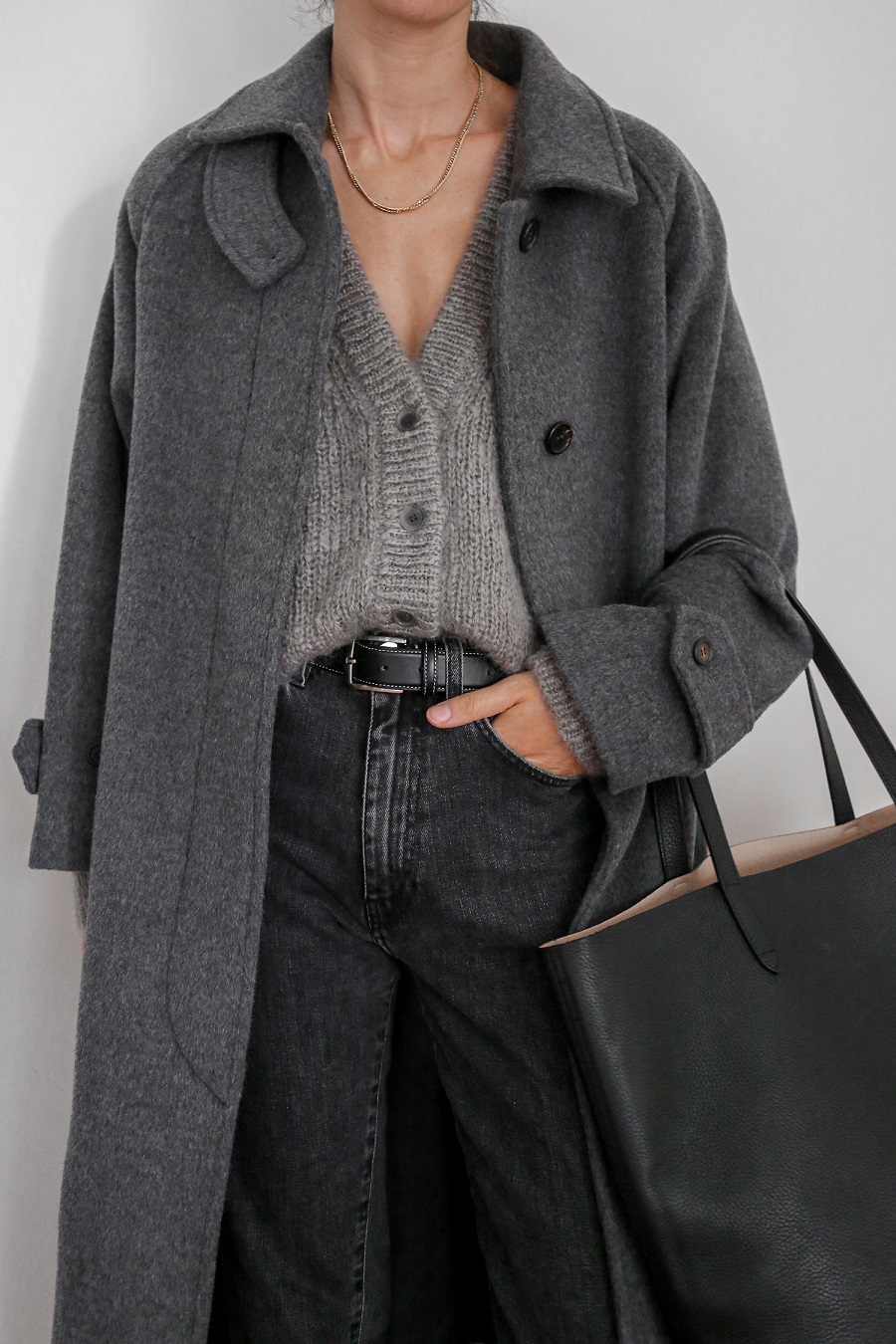
A single deep tone worn head-to-toe — true navy, dark chocolate, forest green — reads as deliberate and strong when the fabrics and textures differ slightly. If the silhouette is doing interesting work, colour contrast would only compete with it. High contrast needs simple shapes to land properly. Save it for when the structure is quiet.
How to Train Your Eye Without Expensive Mistakes
This is the part most style advice skips — the actual process of building colour instinct rather than just cataloguing the theory.
Should You Start With a Neutral Wardrobe?
Yes — but not for the logistical reason usually given. The standard advice is to build a neutral base so everything works together. That is about wardrobe management. The real reason to start with neutrals is that they make the learning faster.
If 80% of your wardrobe sits in dark navy, charcoal, camel, and off-white, introducing one new colour becomes a controlled experiment. You can observe exactly how the new tone interacts with each existing piece. You see whether it creates contrast or clash against your specific items. That feedback loop is faster and far cheaper than buying multiple colour pieces and hoping they work together.
One mistake here: neutrals are not all the same temperature. Camel and charcoal are both neutral but one is warm and one is cool. If your neutral base skews all warm or all cool, the accent colours that work for you will be more limited. A mixed-temperature neutral base gives you more flexibility when you start adding colour.
How Do You Know If a Pairing Is Actually Working?
The fastest test: take a photo of the outfit and desaturate it to black-and-white. In greyscale, a good contrast pairing still shows clear value separation — the tones read as distinctly different shades of grey. If they merge into a single mid-grey blob, the contrast is not working. You have two tones at the same value, and they will look muddy in person regardless of how the colours relate to each other on a wheel.
This is the same check photographers use when reading exposure. It works for clothing for exactly the same reason — luminance contrast is the structural foundation that everything else sits on.
What Builds Real Colour Instinct Over Time?
Look at fashion editorials — not for the trends, but for the ratios. Notice that in most well-art-directed images, one colour dominates and one accents. Notice how rarely two vivid colours appear at equal weight. Notice how often the interesting pairings are simply two muted tones in different temperature families with one clearly leading.
Then look at Impressionist and post-Impressionist paintings. Cézanne was working out warm-cool contrast directly: the warm light side of a surface against the cool shadow side. That is the same tension a warm-toned coat creates against a cool-toned room or background. The visual logic is identical across painting and clothing — and looking at it in paint makes the principle easier to see because the brushwork makes it explicit.
One concrete exercise worth doing: pull ten outfits you have worn and liked, photograph them, then write down the dominant tone, the accent tone, and the approximate split ratio. Patterns will emerge. You will find you have already been gravitating toward specific contrast types without naming them. Naming them makes the next purchase decision sharper — and makes it easier to identify when something in a shop window is working on you and why.
This is not financial advice — and it is not a guarantee that any specific pairing will land in every context. Colour perception is partly personal, partly cultural, partly a function of the light in the room. What understanding the mechanics gives you is a faster diagnosis when something is not working — and that alone is worth the effort of learning it properly.