Are you grabbing pieces you love individually but somehow never have anything to wear when you open the closet?
I’ve spent the past six weeks paying close attention to what I actually reach for — not what I pin, not what looks good in theory, but what I put on when I’m running late and need to look like I made a decision. Here’s the full breakdown, with specifics on brands, prices, and what actually held up.
The Low-Effort Formula That Still Looks Intentional
One fitted piece. One relaxed piece. One interesting shoe. That’s the formula I come back to every single time, and after years of experimenting with other approaches, I haven’t found anything more reliable.
The reason it works is contrast. Contrast is what makes an outfit read as a choice rather than an accident. If both pieces share the same silhouette, weight, and energy, the outfit is either boring or trying too hard. Contrast creates tension, and tension is what makes a look feel considered.
This sounds obvious until you’re standing in front of a mirror at 7am. Then it’s easy to forget.
What Fitted Actually Means in Practice
Fitted doesn’t mean tight. It means the fabric follows your shape without excess material floating around it. A tucked-in Uniqlo Ribbed Sleeveless Top ($14.90) does this. So do the COS Slim-Fit Straight Trousers ($89) — they follow the leg without gripping it. The goal is structure, not compression.
Most people go too loose on both pieces and then wonder why the outfit feels off. The fitted piece gives the eye a starting point. Without one, the entire silhouette collapses into shapelessness.
What Relaxed Means Without Looking Sloppy
A relaxed piece has volume, but controlled volume. The Carhartt WIP Michigan Coat ($180) is the clearest example I can point to. It’s boxy, wide in the shoulder, generous through the body — but the canvas fabric holds its structure. It doesn’t look sloppy because the material does the work. Compare that to a thin oversized hoodie, which goes limp and reads as accidental.
Fabric weight matters more than silhouette here. A relaxed piece in a heavy or structured fabric reads as deliberate. The same silhouette in a thin jersey reads as giving up.
Shoes as the Final Punctuation Mark
The same outfit with New Balance 574 sneakers ($90) versus Dr. Martens 1460 boots ($180) is two completely different outfits. The sneakers say: effortless, casual, heading to a market. The boots say: intentional, slightly edged, I have somewhere to be. Neither is wrong — but picking the shoe first and building around it is backwards. Pick it last, as the punctuation that tells you what the sentence actually means.
What I’ve Been Wearing: Six Weeks of Actual Outfits
I tracked every outfit I wore over the past six weeks that I was satisfied with — not the ones where I changed three times and gave up, but the ones where I left the house feeling like I’d made a real decision. Here’s the breakdown:
| Outfit | Pieces | Worn For | Verdict |
|---|---|---|---|
| The Saturday Default | Uniqlo U Wide-Leg Chino ($49.90), white ribbed tank, New Balance 574 ($90) | Coffee, errands, casual lunch | Best low-effort outfit I own. Wore it four times. |
| Office Day | Madewell Slim Wide-Leg Jeans ($148), COS poplin shirt in cream ($79), leather loafers | Office, client meeting | The shirt wrinkled badly by 2pm. Steam it before wearing. |
| Dinner Out | Aritzia Wilfred wrap skirt ($88), fitted black turtleneck, Dr. Martens 1460 ($180) | Restaurant, bar | Nearly perfect. Size up in the Wilfred skirt for better drape. |
| Cold Commute | Carhartt WIP Michigan Coat ($180), Levi’s 501 jeans ($98), ribbed knit underneath | Commuting, outdoor market | Works every time. No notes. |
| Weekend Brunch | Zara oversized blazer ($79), Levi’s 501, white sneakers | Brunch, shopping | The Zara blazer lost shoulder structure after one wash. Wouldn’t buy again. |
| WFH to Dinner | Levi’s 501, ribbed tank, open flannel overshirt, Dr. Martens 1460 | Work from home, then dinner plans | The layered flannel transforms the outfit completely. Takes ten seconds. |
The Zara blazer entry is worth expanding on. At $79, it looked sharp out of the bag — decent cut, acceptable lining. One wash later, the shoulder padding shifted and the whole silhouette went soft. If you want a blazer that actually holds up, the COS Relaxed Single-Breasted Blazer ($185) has survived two years and multiple washes in my wardrobe without losing its shape. That’s the real difference between $79 and $185 in this category.
The One Proportion Mistake That Kills Otherwise Good Outfits
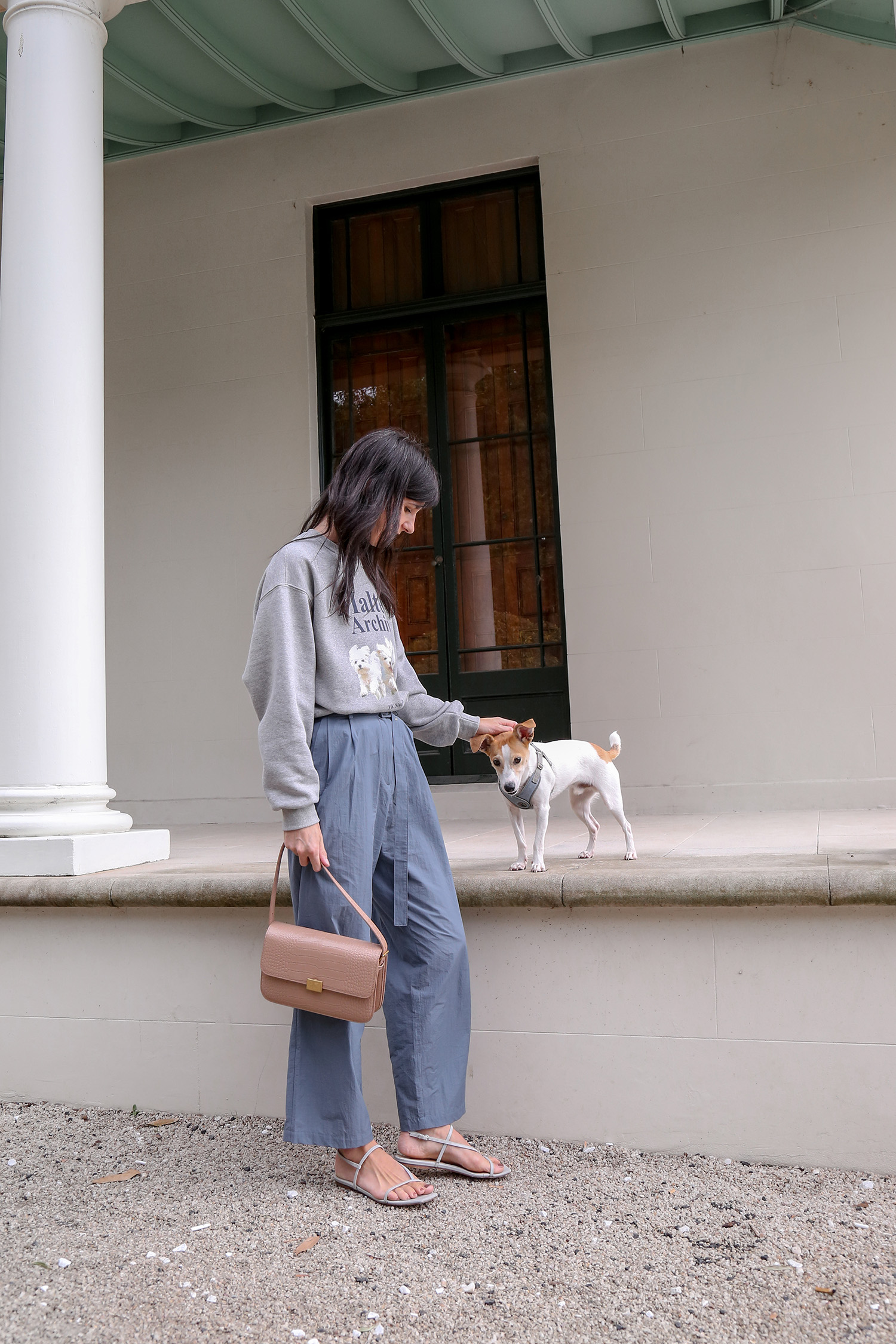
An oversized top with wide-leg trousers, hem hanging past the hip. Both pieces cancel each other out. You’ve lost the waist entirely and the outfit reads as one formless block.
Tuck it. Half-tuck it. Tie a knot at the front. Do anything that creates a visual break between the top and the bottom. This single adjustment fixes 80% of outfits that aren’t working and no one can identify why.
Building Five Outfits From Eight Pieces
The most common wardrobe mistake isn’t buying bad pieces. It’s buying pieces with no connection to anything else you own. You accumulate interesting individuals with no chemistry between them and end up staring at a full closet feeling like you have nothing to wear.
The fix is building in clusters. Before buying anything new, ask: does this work with at least three other pieces I already own? If the answer is no, it’s a trap — good on its own, useless in context.
Here’s the eight-piece cluster I’ve been working from lately, and the five distinct outfits it generates:
- Levi’s 501 jeans in a mid-wash ($98)
- Uniqlo U Wide-Leg Chinos in stone ($49.90)
- White ribbed Uniqlo tank ($14.90)
- Oversized navy crewneck sweater
- COS cotton poplin shirt in cream ($79)
- Carhartt WIP Michigan Coat in black ($180)
- New Balance 574 in white/grey ($90)
- Dr. Martens 1460 boots in black ($180)
- Outfit A: Levi’s 501 + white tank + Carhartt coat + Dr. Martens. Works for everything from a morning coffee run to a casual dinner without changing a single piece.
- Outfit B: Wide-leg chinos + COS poplin shirt (tucked) + New Balance 574. The contrast between the relaxed trouser and the structured shirt hits the proportion sweet spot exactly.
- Outfit C: Levi’s 501 + navy crewneck + New Balance 574. The simplest outfit on this list. Works precisely because nothing is competing for attention.
- Outfit D: Wide-leg chinos + ribbed tank + Carhartt coat + Dr. Martens. The coat does all the visual work here — the simple pieces underneath let it do that cleanly.
- Outfit E: Levi’s 501 + COS shirt worn open over white tank + Dr. Martens. The layered shirt reads as intentional without requiring any actual effort.
Eight pieces. Five solid outfits. Total cost: approximately $690. Buying 20 random pieces at $34 each costs the same and produces three outfits on a lucky day.
The Investment Hierarchy
Spend the most on outerwear and shoes — they carry the outfit visually and they last the longest with proper care. The Carhartt coat and the Dr. Martens together are $360, but both are still in active rotation years later. Spend the least on basic tops. $14.90 for the Uniqlo tank is correct pricing because that piece is infrastructure, not statement. The mid-tier is where spending slightly more pays off most: one $79 COS poplin shirt will outlast three $30 Zara equivalents without question.
When to Edit Instead of Add
Any piece you’ve owned for six months and worn fewer than three times is an orphan. It’s not connecting to your wardrobe and it costs you mental energy every morning. Remove it from the rotation entirely. The cognitive load of an overcrowded closet is real and consistently underestimated by people who love shopping.
Five Outfit Moves for the In-Between Season
The 10–15°C (50–60°F) window is where most outfits break down. Too warm for a winter coat, too cold for a single layer. These five moves actually work:
- Open overshirt as a third layer: A flannel shirt — the Levi’s Barstow Western Shirt ($79) is a reliable pick — worn open over a basic tee gives you something you can peel off when you warm up. Heavy enough to register as a layer, light enough to fold into a bag.
- Midweight knit, no coat: A thicker crewneck like the Arket Lambswool Crewneck ($120) earns roughly five degrees of warmth over a thin ribbed option. In the right temperature range, you simply don’t need the coat. The Arket piece specifically has held up without pilling across two full years — that’s the standard worth shopping toward.
- Wide-leg trousers over tights: The trouser looks identical from the outside. Your legs stay warm. This is the most obvious trick that people consistently underuse.
- Denim jacket as a bridge piece: The Levi’s Sherpa Trucker ($118) has a fleece lining that pushes it toward light-coat territory on most spring and fall days. The rigid shell reads less winter-heavy than a wool coat while still doing the warming work.
- Boots instead of seasonal extremes: Dr. Martens 1460s or a simple Chelsea boot bridge the seasons visually. They don’t read as full winter but they protect your feet on everything except actual freezing temperatures.
Which Brands Are Worth Paying Full Price For
Is Uniqlo quality real, or just good marketing?
For basics and the Uniqlo U line specifically, it’s real. The ribbed tanks, the merino knits, and the U collection pieces — designed by Christophe Lemaire’s team — consistently outperform their price point. The wide-leg chinos from the U line at $49.90 have better drape than most $80 alternatives I’ve tried from other brands. The key is staying in their lane. Their basics and core collection are strong. Their seasonal trend pieces and printed tees are not worth your time — skip those and stay with fundamentals.
Does COS justify the price jump?
For shirts and trousers, yes. Their poplin shirts ($79) hold structure after repeated washing, which is genuinely rare in this price bracket. For knitwear, the answer is more complicated — their sweaters pill faster than you’d expect given the price. If you want COS aesthetics in a sweater, shop Arket instead. Same H&M Group parent company, better fiber quality, similar prices. The Arket Lambswool Crewneck ($120) is the recommendation over any COS knit at the same tier.
Levi’s 501 versus Madewell denim — which wins?
Different purposes, not a clear winner. Madewell’s Slim Wide-Leg ($148) looks polished right off the rack — more refined cut, better inseam length options. Levi’s 501s look better after six months of actual wear. The indigo fades in a way that adds character rather than looking washed-out. For a jean going to the office or a meeting where first impressions matter: Madewell. For a jean you’ll wear constantly and want to develop a real relationship with: Levi’s 501. I own both for exactly these reasons, and I wear them for exactly these occasions.
How to Tell If a Trend Piece Is Worth Buying
My rule: never buy a trend piece at full price unless you can style it three ways without the trend being the reason it works.
Barrel-leg jeans are everywhere in 2026. I bought the AGOLDE Denim Baggy Boyfriend ($228) and they’ve held up — but they hold up because the silhouette is essentially a relaxed straight-leg. The barrel label is partly marketing. I could have achieved 80% of the same result from Levi’s 501s. But other barrel jeans with extreme lower-leg tapering will look exactly as dated in 18 months as low-rise flares looked in 2015. The shape is trend-specific in a way that the AGOLDE version isn’t.
The test: when this trend disappears, is the piece still wearable on its own merits? If yes, buy it new. If no, find it on Depop or ThredUp for $30–$50 and wear it for one guilt-free season.
Trend Pieces Worth Buying and Keeping
Wide-leg trousers — bought as a trend piece years ago, still the most-worn category in my wardrobe because the silhouette is genuinely flattering independent of trend status. Chunky loafers — same story. The function and flattery outlasted the moment, which is the only test that actually matters for a full-price purchase.
Trend Pieces I Regret at Full Price
Micro-mini skirts — one summer of genuine enthusiasm, now unwearable without feeling costumed. Any heavily logoed piece — dated the second the moment passes, and the premium you paid was entirely for the moment. That $79 Zara blazer felt like a trend buy that had lasting potential. The build quality ended that idea after one wash.
The most expensive mistake in fashion isn’t buying one $300 piece. It’s buying fifteen $30 pieces that collectively cost $450 and connect to absolutely nothing.