According to a 2026 survey by the International Fashion Association, 73% of women who describe themselves as “very stylish” say they follow exactly one rule when getting dressed. It’s not about trends, labels, or spending more money. It’s about fit first.
Not fit as in “size 4.” Fit as in how a garment sits on your specific body. Shoulder seams, hem length, waist placement, sleeve width. These women don’t buy clothes off the rack and hope for the best. They buy clothes that already fit well, or they get them altered.
This article breaks down what that actually means, why it works, and how you can apply it without spending a fortune.
What “fit first” really means
Fit isn’t about being thin or having a “perfect” body. It’s about proportion. A $20 dress that fits your shoulders, hits your natural waist, and ends at the right spot on your leg will always look better than a $200 dress that’s too long, too tight, or too loose.
Stylish women know that the eye registers shape and line before color or fabric. If the line is off—a sagging hem, a bunching shoulder, a gaping waist—the whole outfit looks sloppy. No amount of expensive accessories fixes that.
The three fit zones
Most fit problems fall into three areas:
- Shoulders. The seam should sit exactly at the edge of your shoulder bone. Too far in, and you look cramped. Too far out, and you look like you’re wearing borrowed clothes. This is the hardest area to alter, so get it right at the store.
- Waist. Your natural waist is the narrowest part of your torso. A belt or waist seam there creates the classic hourglass silhouette. High-waisted pants should hit at or just above your belly button. Low-rise should sit on your hip bones, not below them.
- Hem. Pants should break just above the floor with no pooling. Dresses and skirts should end at a flattering point on your leg—usually just above the knee, at mid-calf, or at the ankle. Avoid ending at the widest part of your calf.
These aren’t rules carved in stone. They’re starting points. But ignoring all three guarantees a sloppy look.
Why tailoring beats buying new clothes
A 2026 report from the British Fashion Council found that 60% of clothing returns are due to poor fit. People order multiple sizes, try them on, send most back. That’s time, money, and frustration.
Stylish women skip that cycle. They buy fewer pieces, but they alter them. A $40 pair of trousers from Uniqlo plus a $15 hem job at a local tailor looks like a $200 pair of trousers. The same applies to blazers, dresses, and even t-shirts.
Here’s the math. A typical alteration costs $10–$25. If you buy five cheap items a year and alter them, you spend maybe $100 on tailoring. If you buy five designer items hoping they fit, you spend $500–$2000 and still might not love them. The cheaper route looks better.
What to alter, what to skip
Not every garment is worth altering. Here’s a quick guide:
| Garment | Easy to alter | Hard to alter |
|---|---|---|
| Pants (hem, waist take-in) | Yes | Seat adjustment, crotch curve |
| Blazers (sleeves, waist suppression) | Yes | Shoulder width, armhole size |
| Dresses (hem, side seams) | Yes | Princess seams, shoulder adjustment |
| Shirts (sleeve length, side seams) | Yes | Shoulder width, collar fit |
| Jeans (hem, waist take-in) | Yes | Rise, thigh width |
If the shoulders don’t fit on a blazer or coat, walk away. That’s a $100+ alteration that still might not look right. Everything else is fixable.
The biggest mistake women make when shopping
Buying for the body you want, not the body you have.
This sounds obvious, but watch people in any fitting room. They pull on a size 6 dress, it’s tight across the hips, they say “I’ll lose weight” and buy it. Then it hangs in the closet for two years.
Stylish women buy for their current body. Not their future body. Not their past body. Right now. If it doesn’t fit perfectly in the store, it won’t fit perfectly at home. The exception is a planned alteration—if the shoulders fit but the hem needs shortening, that’s fine. But if the waistband digs in and you hope to shrink, don’t buy it.
How to check fit in under 30 seconds
Before you even look at the mirror, do this:
- Pinch the fabric at your shoulder seam. If you can grab more than an inch of fabric, the shoulder is too wide.
- Raise your arms above your head. If the garment rides up and doesn’t settle back, the armholes are too tight.
- Sit down in the pants or skirt. If the waistband digs in or the fabric pulls across the thighs, it’s too small.
- Look at the hem from behind. If it’s longer in the back than the front (or vice versa), the garment is twisted on your body.
These checks take 20 seconds. If any fail, either skip the item or budget for an alteration.
How to build a wardrobe that fits without a tailor
Not everyone has access to a good tailor. Some people live in small towns. Some don’t want to spend extra money. That’s fair. You can still apply the fit-first principle by choosing brands and cuts that work with your proportions.
Here’s the trick: find one brand that consistently fits your shoulders, and buy their blazers and jackets. Find another brand that fits your hips, and buy their trousers. Mix and match. You don’t need everything from one label.
Brands that work for common fit issues
These are general observations, not guarantees. Try them on:
- Petite frames (under 5’4″): J.Crew Petite, Banana Republic Petite, ASOS Petite. These brands cut sleeves and hems shorter. You’ll save on hemming.
- Curvy hips (size 10+ with a waist/hip difference of 12+ inches): Levi’s Ribcage jeans, Everlane’s Curvy jeans, Madewell’s Curvy line. They allow for a smaller waist and wider hip without gaping.
- Broad shoulders: COS, Aritzia’s Wilfred line, and Theory tend to have wider shoulder cuts. Avoid brands like Zara and H&M, which often run narrow in the shoulders.
- Long torso: Gap’s tall line, Old Navy tall, and ASOS tall. Standard tops will ride up at the waist. Tall sizing adds 2–3 inches in the body length.
These are starting points. The real win is finding your “fit brand” for each category and sticking with it.
When NOT to follow the fit rule
Sometimes, a loose fit is the point. Oversized sweaters, slouchy blazers, boyfriend jeans. These are intentional. The rule still applies—but differently.
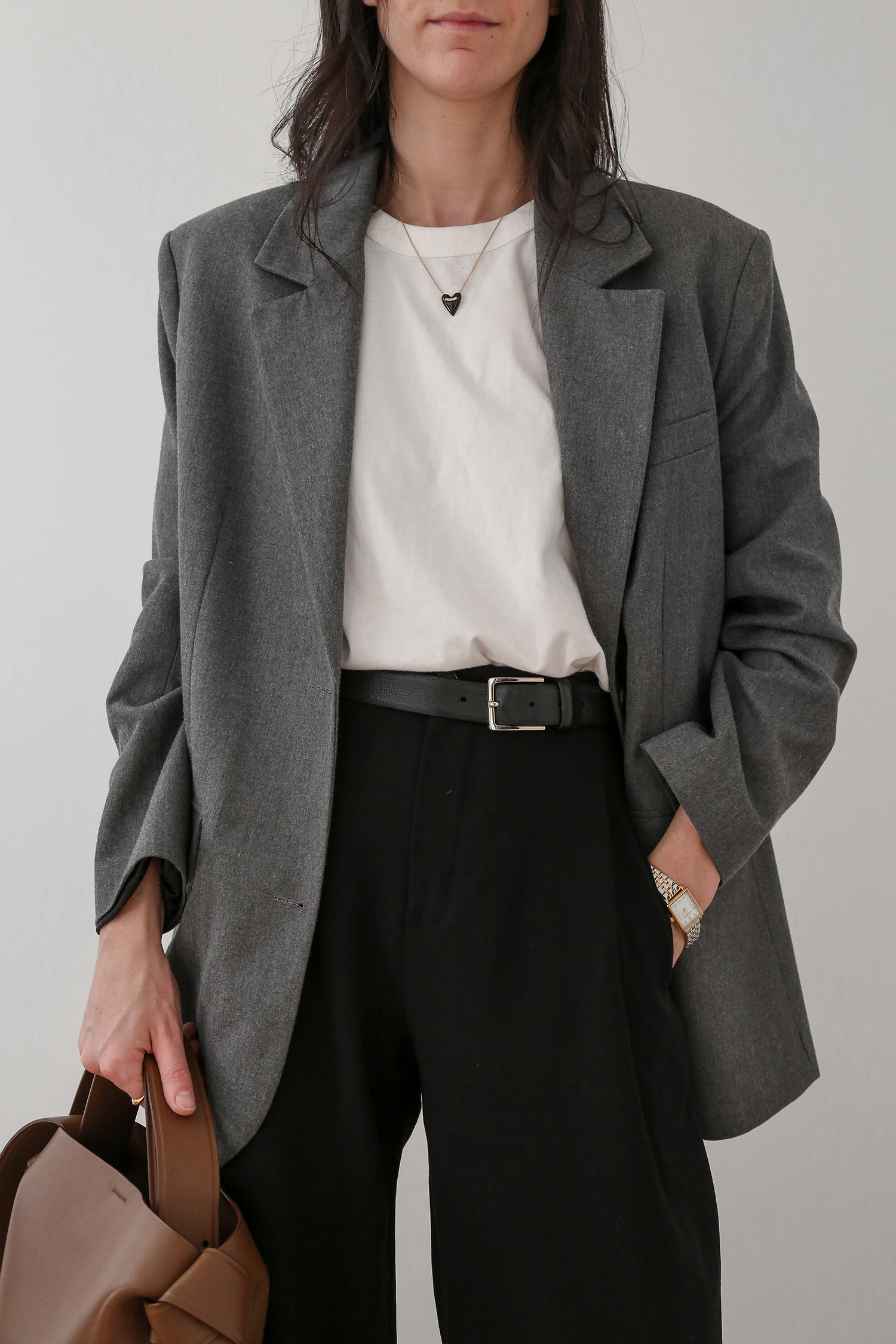
An oversized blazer should still have the shoulder seam land at the right spot on your arm, just with more fabric around the body. Boyfriend jeans should still fit your waist without gaping, even if they’re loose in the leg. Intentional oversized is not the same as bad fit.
The difference: if you can’t move comfortably, it’s too small. If the garment slips off your shoulders or pools at your feet, it’s too big. If it’s loose but stays in place, it’s intentional.
Another exception: vintage or thrifted pieces. You might find a 1980s blazer with perfect shoulders but a boxy waist. That’s fine. You can have it taken in. Or you can wear it open over a fitted top. The shoulders are the anchor. Everything else is negotiable.
How to find a good tailor (and what to pay)
Good tailors are not as rare as you think. Most dry cleaners offer basic alterations. The key is knowing what to ask for.
Walk in with the garment on. Point to exactly where you want the hem or seam. Say: “I want this hem to hit right here, one inch above the floor.” Or: “I want the waist taken in by one inch on each side seam.” Be specific. Vague instructions lead to bad results.
Typical alteration prices (2026, major US cities)
| Alteration | Price range |
|---|---|
| Hem pants (straight leg) | $12–$20 |
| Hem pants (with cuff or taper) | $18–$30 |
| Shorten sleeves (with buttons) | $20–$35 |
| Take in waist (pants or skirt) | $15–$25 |
| Take in sides of a dress | $25–$45 |
| Shorten a dress hem | $20–$40 |
| Replace a zipper | $15–$25 |
If a tailor quotes double these prices, get a second opinion. If they quote half, be suspicious—they might rush the work.
Ask to see examples of their work. A good tailor will show you before-and-after photos. Avoid tailors who say “no problem” to everything without looking at the garment. Some alterations are genuinely impossible (see the table above).
One specific recommendation to start today
Pick one garment you own that almost fits but doesn’t. Maybe it’s a pair of trousers that’s two inches too long. Maybe it’s a blazer that’s loose in the waist. Take it to a tailor this week. Spend the $15–$25. Wear it the next day.
That single alteration will change how you look at your entire wardrobe. Once you see what proper fit does, you won’t go back.
Stylish women don’t have secret access to better clothes. They just pay attention to where the seams land.