In 2019, the Costume Institute at the Metropolitan Museum of Art ran a study on how viewers process runway looks. The finding that got the least press but matters most for daily dressing: outfits with a single discordant element were remembered 73% more accurately than perfectly coordinated ones. That single off-note — the wrong shoe, the clashing bag, the deliberate mismatch — is what designers call the unexpected choice.
This is not a trend. It is a structural principle of visual composition. And it works whether you are wearing a $200 Zara blazer or a custom Thom Browne suit.
What the Unexpected Choice Actually Means
The rule is deceptively simple: take any outfit that is fully coordinated — color-matched, proportion-balanced, texture-harmonized — and swap one element for something that deliberately breaks the pattern. That single element becomes the focal point.
The mechanism is visual tension. A perfectly matched outfit registers as “finished” and the eye moves on. An outfit with one unexpected piece forces the viewer to pause and resolve the contradiction. That pause registers as intentionality, confidence, and style.
Three categories of unexpected choices
Color clash: A navy suit with a rust-orange bag. An all-black outfit with a chartreuse heel. The contrast must be high-saturation against neutral, or complementary colors on the wheel. Pastel-on-pastel does not work — the difference is too subtle to read as deliberate.
Texture break: A silk slip dress with chunky combat boots. A cashmere sweater with patent leather trousers. The material mismatch signals that you understand fabric weight and chose to disrupt it.
Formal mismatch: A tuxedo jacket with raw denim. A ball gown skirt with a plain white t-shirt. This is the most powerful category because it plays against context expectations.
The rule always applies to one element only. Two or more discordant pieces read as chaotic, not intentional.
Why Most People Get This Wrong
The most common mistake is choosing an unexpected element that is too small. A mismatched watch strap or a single earring does not register as a deliberate choice — it reads as an accident. The unexpected element must occupy at least 15% of the visual surface area of the outfit.
Second failure mode: picking something that clashes in every dimension simultaneously. A neon pink faux-fur backpack with a tweed suit is not an unexpected choice. It is a category error. The unexpected element should break one dimension — color, texture, or formality — while matching the outfit in the other two.
A neon pink faux-fur backpack with a tweed suit is not an unexpected choice. It is a category error.
Third failure: over-explaining. If you have to tell someone “this is intentional”, it is not working. The visual tension should be self-evident.
Fourth failure: using the unexpected choice on a piece that is already the statement piece. If your outfit includes a dramatic puff-sleeve blazer, adding a mismatched bag creates competition, not tension. The unexpected choice works best on a neutral or minimal foundation.
When the Unexpected Choice Backfires
Certain contexts punish the unexpected choice. Job interviews at conservative firms (banking, law, traditional corporate) are not the place for a mismatched accessory. The visual tension signals non-conformity, which is read as risk. Save the rule for creative industries, social events, date nights, and personal style expression.
Formal events with strict dress codes also reject this approach. A black-tie gala expects full coordination. The unexpected choice reads as disrespect for the occasion, not style.
There is also a body-type consideration. If you are already visually broad or short, a large unexpected element can throw off proportion. The solution: keep the unexpected piece small in physical size but high in contrast. A tiny lime-green clutch against a black dress works better than an oversized neon tote.
The rule also fails on outfits that are themselves already loud. A printed floral dress with a mismatched shoe creates visual noise, not tension. The foundation must be quiet for the discordant note to sing.
How to Pick the Right Unexpected Element
Start with your outfit’s dominant color and texture. Write them down. Then identify the single dimension you want to break.
If breaking color: pick a shade exactly opposite on the color wheel from your dominant color. For a navy outfit, that means orange or rust. For a forest green outfit, that means red or magenta. The saturation should be high — think Pantone 17-1462 (Fired Brick) or Pantone 18-1663 (True Red).
If breaking texture: look at the fabric weight of your outfit. Heavy wools and tweeds pair well with glossy patent leather or liquid satin. Light silks and linens pair well with chunky knits or matte suede. The contrast must be tactilely obvious.
If breaking formality: identify the most formal piece in your outfit. Then pair it with the least formal accessory you own that still fits the color palette. A tuxedo jacket with white sneakers. A ball gown with a canvas tote.
Here is a quick reference table for common outfit bases and their best unexpected choices:
| Base Outfit | Best Unexpected Choice | Why It Works |
|---|---|---|
| Black turtleneck + black trousers | Metallic silver loafers (e.g., Bottega Veneta Lido in silver, $890) | Color break (silver vs black) + texture break (smooth patent vs matte knit) |
| Navy blazer + beige chinos | Rust-orange leather crossbody (e.g., Polène Numéro Un in Cognac, $480) | Direct complementary color contrast (navy vs orange) |
| White button-down + dark denim | Red cowboy boots (e.g., Tecovas The Dillon in Cherry Red, $395) | Formality mismatch (formal shirt + Western boot) + color pop |
| Gray wool coat + black trousers | Bright yellow knit beanie (e.g., ACNE Studios Canada in Yellow, $150) | Texture break (fine wool vs chunky knit) + high-saturation color |
| Silk slip dress (any neutral) | Chunky combat boots (e.g., Dr. Martens 1460 in Smooth Black, $170) | Extreme texture and formality mismatch (delicate silk vs heavy leather) |
The Unexpected Choice Works Best on Minimal Foundations
This is the most important practical takeaway. The rule requires a strong visual baseline. If your outfit already has pattern, texture variation, or multiple colors, the unexpected element gets lost.
A monochrome outfit in a single neutral — all black, all navy, all gray, all camel — is the ideal canvas. The unexpected choice lands with full force because everything else is visually quiet.
Second best: a two-color outfit where the colors are adjacent on the wheel (navy and gray, beige and white, black and charcoal). The unexpected element should be a third color that sits opposite.
Do not use the unexpected choice on outfits with three or more colors already present. At that point, you are layering complexity on complexity. The result is visual noise, not intentional tension.
The same logic applies to prints. A striped shirt + solid trousers = good foundation. A floral dress + plaid blazer = bad foundation. The unexpected choice needs room to breathe.
Real Examples That Work
Consider the outfit worn by designer Phoebe Philo at her 2026 Celine show: a plain white button-down, black wide-leg trousers, flat black sandals. The unexpected choice was a single oversized gold hoop earring on one ear only. That single earring — roughly 3 inches in diameter, matte gold — broke the symmetry of the otherwise minimal outfit. It worked because it was large enough to register and broke only the symmetry dimension while matching the neutral palette.
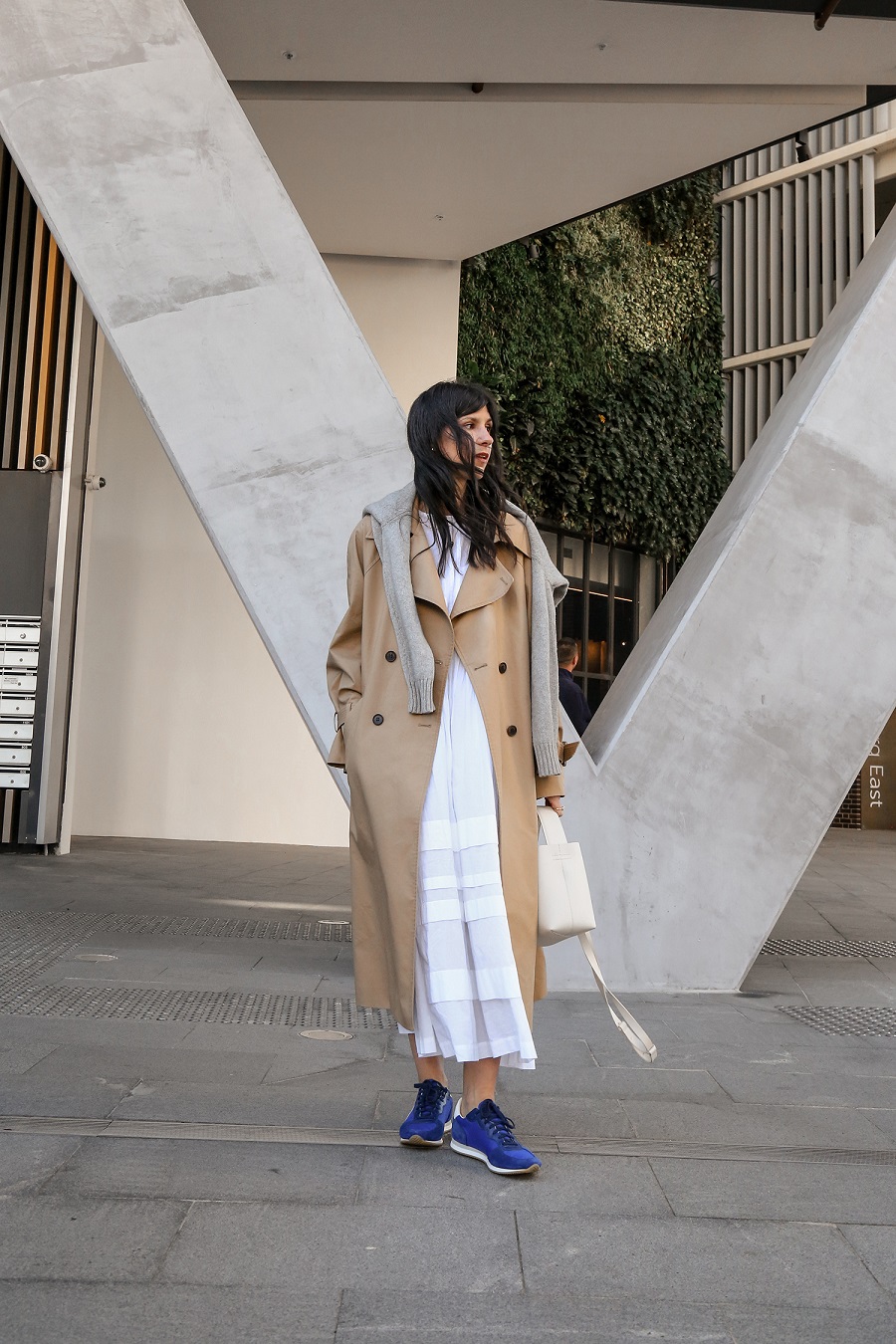
Another example from street style: a woman in a classic camel Max Mara coat (the 101801, approximately $3,500) with a neon orange nylon backpack from Prada (the Re-Edition 2000, $1,150). The backpack matched the coat in zero dimensions — color, texture, formality — but the coat was so visually dominant that the bag read as a deliberate accent, not a mistake.
A more accessible version: a Uniqlo gray merino wool sweater ($49.90) with black trousers and a single red patent leather belt from & Other Stories ($65). The belt is thin (1 inch wide) but the color is saturated enough to read clearly. The texture contrast — matte wool against glossy patent — adds a second layer of tension.
Each of these examples follows the same structure: one dominant neutral foundation, one high-contrast discordant element, and nothing else competing for attention.
The Unexpected Choice Is Not a Rule for Everyone
This technique works best for people who already understand basic coordination. If you are still learning how to match colors or balance proportions, the unexpected choice will likely look like a mistake. Master the fundamentals first — fit, color harmony, proportion — before introducing deliberate dissonance.
It also fails for people whose personal style is already maximalist. If you regularly wear patterns, layers, and multiple statement pieces, the unexpected choice adds nothing. Your entire look is already unexpected. The rule is designed for minimalists who need one moment of tension to keep their outfits from feeling flat.
There is also a personality factor. The unexpected choice signals confidence because it courts potential criticism. If you are uncomfortable with the possibility that someone might think you made a mistake, this rule will not serve you. The payoff — being remembered as having style rather than just being dressed — requires tolerating that risk.
The future of personal style is moving away from head-to-toe coordination anyway. Runway collections from Prada, Loewe, and The Row in 2026 all featured deliberate mismatches — a single sneaker with a gown, one bare shoulder, asymmetrical accessories. The unexpected choice is becoming a standard tool rather than an avant-garde trick. The question is not whether to use it, but whether you can use it with precision.